
Best Pregnancy and Birthing Balls: What a Midwife Actually Looks For
I get asked about pregnancy balls more than almost anything else in my practice and when I’m teaching, usually by mums somewhere in their second or third trimester, hips aching, looking for something that isn't another pillow wedged behind their back. And honestly, a good birthing ball is one of the simplest, cheapest tools you can add to your pregnancy routine.
But not all pregnancy balls are created equal, and I've seen enough wobbly, flat, "will this actually hold me" moments to know that choosing the right one matters. So here's what I tell my own clients to look for, plus the set I keep coming back to recommending.
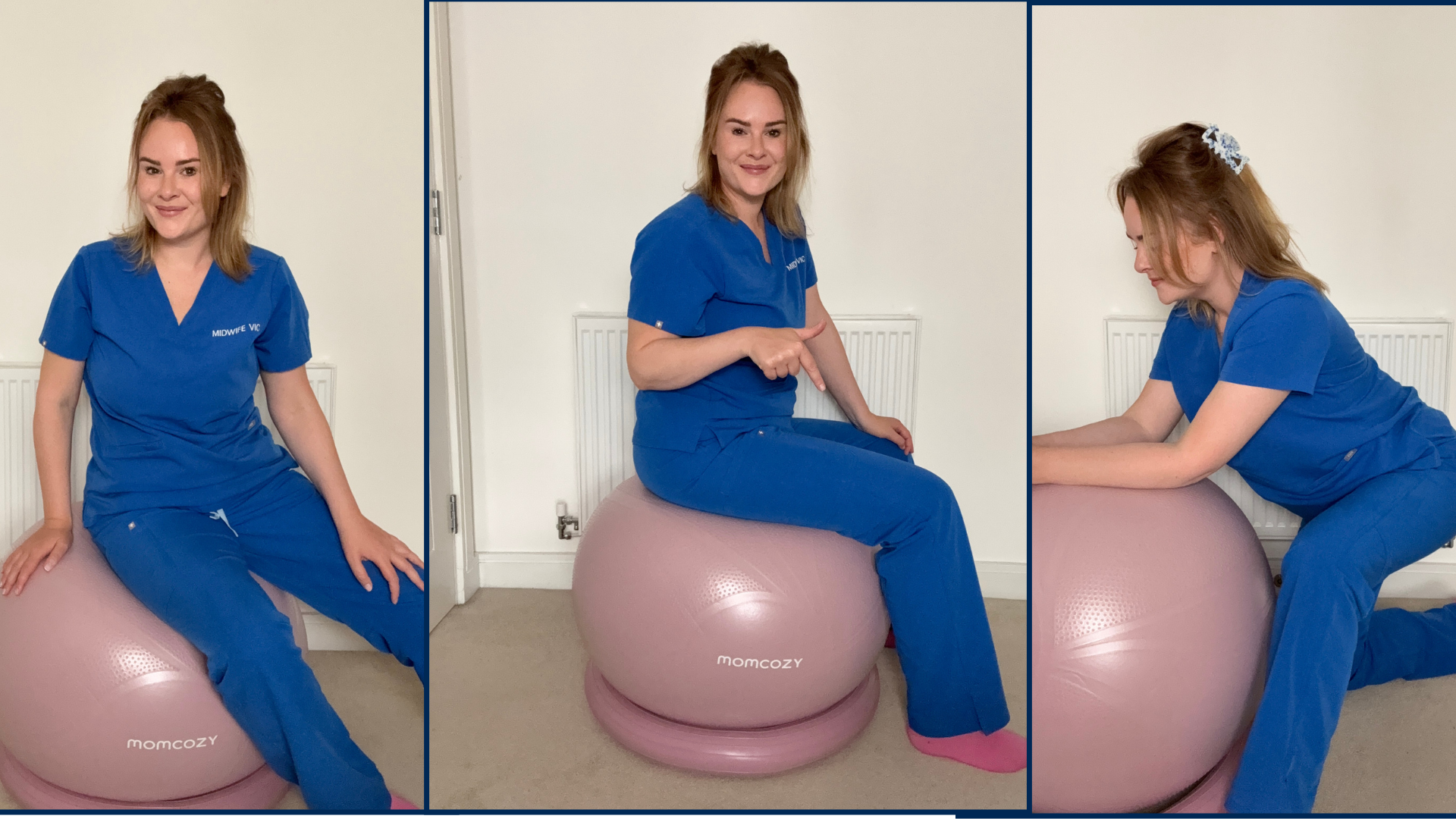
Why Bother With a Pregnancy Ball At All?
As your bump grows, your centre of gravity shifts, your pelvis loosens (thanks to the hormone relaxin), and your lower back and hips end up doing a lot of the work. A pregnancy ball helps in a few genuinely useful ways:
Gentle movement and circulation. Small bounces and hip circles can ease pelvic pressure without any impact
Posture support. Sitting upright on a ball, rather than sinking into a sofa, takes some load off your spine
Labour prep. Many of the positions I teach in my hypnobirthing and antenatal sessions use a ball to help open the pelvis and keep you upright and active
Postpartum use. Gentle, supported movement can also have a place once you're cleared to start moving again after birth
You often see women bouncing on a ball to try and induce labour. I’m afraid that's not how that works. What it can do though, is help your baby find a good position and support your own comfort and mobility once things are already underway. Gentle movement in pregnancy is generally encouraged for uncomplicated pregnancies, but always check in with your own midwife first, especially if you've had any complications or been advised to limit activity.
Getting the Size Right (This Bit Actually Matters)
This is the part people skip, and it's the part that changes how useful your ball actually is. Size is usually based on your height:
Under 5'3" (160cm): a 55cm ball
5'3" to 5'8" (160 to 173cm): a 65cm ball
5'8" to 6'0" (173 to 183cm): a 75cm ball
Over 6'0" (183cm): an 85cm ball
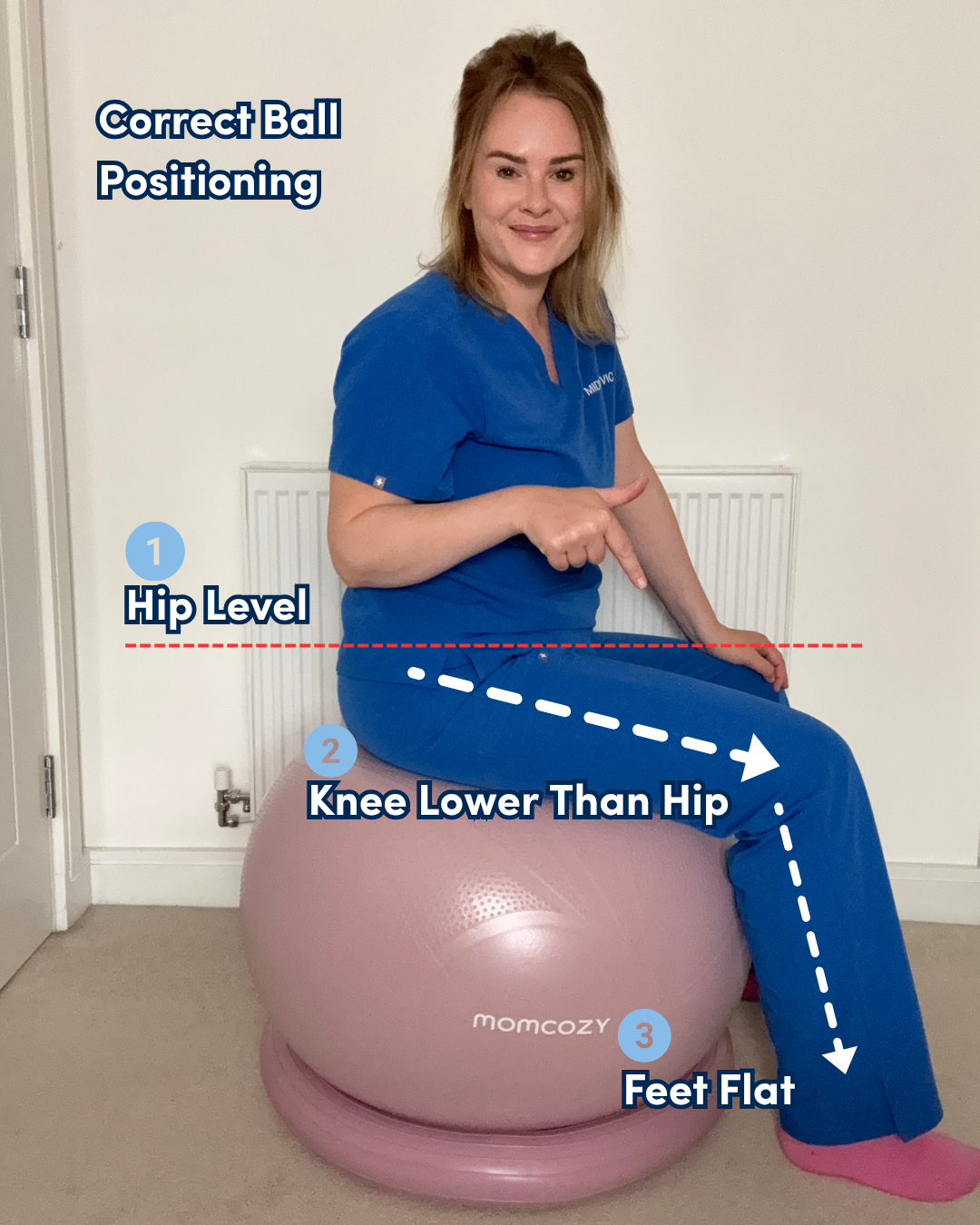
Once you're sitting on it, here's the check I actually teach: feet flat on the floor, hip width apart, and your knees should sit slightly lower than your hips rather than level with them. Your thighs should slope gently downward from hip to knee, not upward.
This is different from the "90 degree angle" you'll see quoted a lot online. A true 90/90 position, where hips and knees are both at right angles, tends to close the pelvis slightly rather than open it.
What you actually want is a bit more open than that at the hip, which is what helps with pelvic alignment and gives your baby a bit more room to get into the optimum position for birth.
If your knees are higher than your hips, size up or add more air. If your feet don't reach the floor properly, size down.
What Else to Look For When Choosing One
Beyond size, here's what I'd want you to check before you buy:
A genuinely stable base. A standard gym ball will roll if you lean the wrong way. Look for one with an anti-slip surface, and ideally a stability ring or base, especially if this is your first time using one, or you're using it later in pregnancy when balance is trickier
Anti-burst, BPA-free material. You want a ball that's rated to deflate slowly rather than suddenly if it's ever punctured, and materials that haven't been treated with anything you wouldn't want near your bump
A sensible weight rating. Check it's rated well above what you'll actually need, for peace of mind
Guidance on how to actually use it. A ball on its own is just a ball. What makes the difference is knowing which movements are safe for your stage of pregnancy, and which to leave alone
A pump included. A small thing, but not having to hunt one down or drive to a garage forecourt makes a difference on delivery day
How the Options Actually Compare
To make this easier to picture, here's how a standard gym ball and a basic no-frills pregnancy ball stack up against a purpose-built set like the Momcozy BirthEase, on the things that actually matter for pregnancy use:
As you can see, the gap isn't really about whether a ball is round and bounces. It's whether it's actually been built with a pregnant body in mind that actually wants practical results from using one. That's the bit that a stability base and some proper guidance solves.
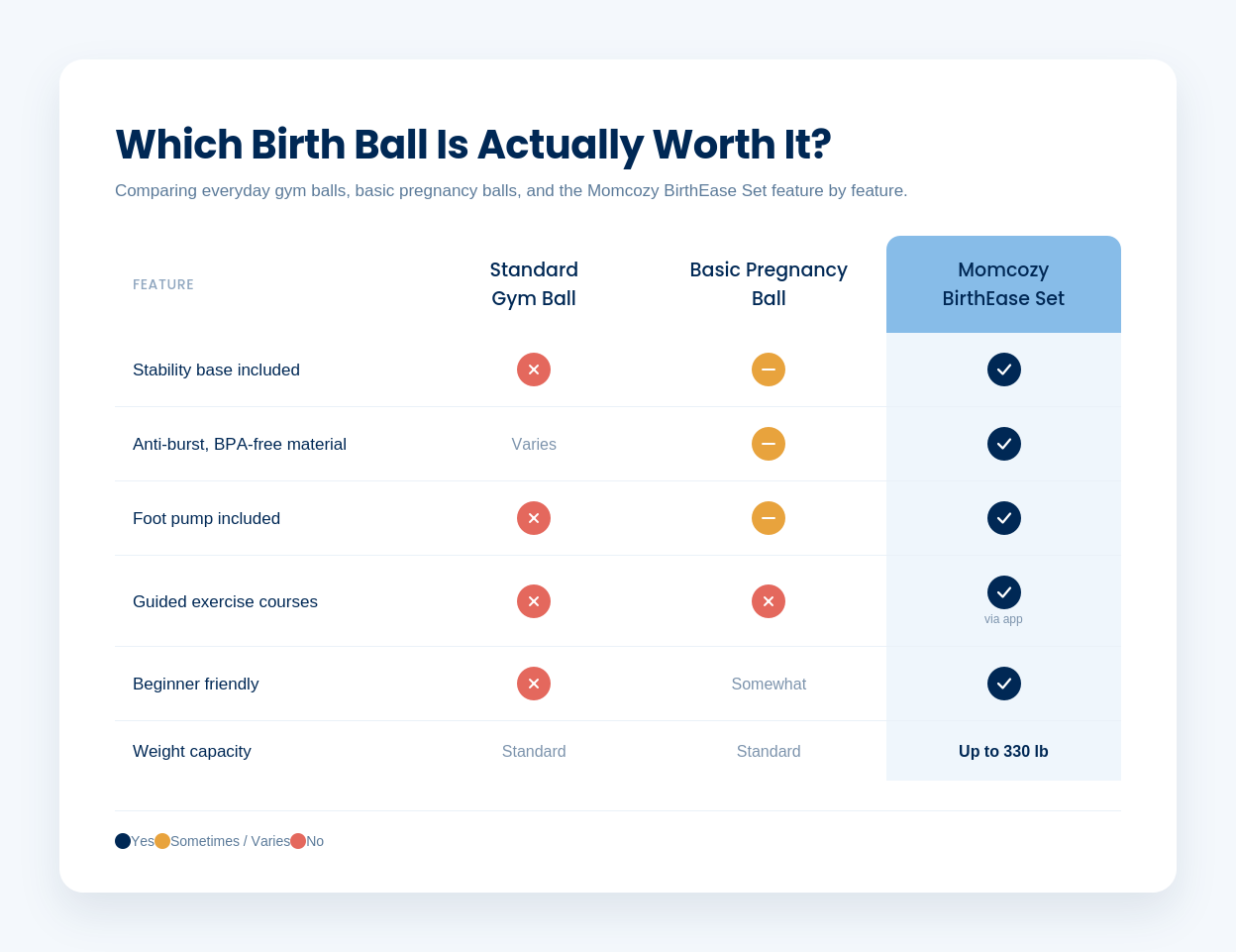
Chart showing the differences between standard gym ball, basic pregnancy ball and the Momcozy Birthease Set
My Pick: Momcozy BirthEase Pregnancy Ball Set
Out of the sets I've tried and had clients test, the Momcozy BirthEase Pregnancy Ball Set is the one I keep recommending, particularly for mums who are nervous about using a ball for the first time.
A few things stand out to me:
The stability base ring. This is the detail that makes the biggest difference for beginners. It stops the ball rolling away from you mid movement, which is exactly the kind of thing that puts people off using one altogether. It's a small design choice that makes a real difference to confidence
The app guided courses. Rather than leaving you to guess your way through positions, the set connects to guided video courses that walk you through what's safe and useful at each stage, from early pregnancy right through to postpartum. As someone who spends a lot of my working life explaining why a movement helps and how to do it safely, I like that this takes some of that guesswork off your plate at home
The overall set design. It comes with a foot pump for easy setup, a textured anti-slip surface, and BPA-free, anti-burst material rated to a high weight capacity, all the boxes I'd tick when advising a client on what to buy
It won't fix everything overnight (nothing does, in pregnancy), but as a low cost, low effort addition to your routine, it's one of the tools I'm genuinely happy to put my name behind.
A Final Note
Whichever ball you go for, the same rule applies as with most things in pregnancy: start gently, listen to your body, and check in with your midwife if anything feels off rather than pushing through discomfort.
Used well, a pregnancy ball is one of the simplest ways to give yourself a head start with comfort in pregnancy, optimal positions ( and therefor shorter labour length ) for birth and generally feeling a bit more a bit more prepared for what's ahead
.
You've got this.
Article written by Midwife Vic
Sponsored by Momcozy